
Exellius, ZoomInfo, and Apollo.io are leading B2B data platforms, but they serve different layers of the revenue stack. ZoomInfo is best for enterprise-grade GTM intelligence and intent data, Apollo.io is designed for all-in-one prospecting and outbound sales execution, while Exellius focuses on data verification, enrichment workflows, and CRM data accuracy.
The right choice depends on team maturity:
- Enterprises prefer ZoomInfo for scale and buyer intelligence
- SMBs and SDR teams prefer Apollo.io for speed and outreach execution
- RevOps and data teams prefer Exellius for cleaner, verified CRM data
In 2026, buying decisions are driven less by database size and more by data accuracy, enrichment workflows, pricing model, and outbound efficiency.
Quick Comparison
| Platform | Pricing Model | Best For | Standout Strength | Main Trade-off |
| Exellius | Credit-based (Free / $59 / $119 / $199 tiers) | Verified prospecting + enrichment workflows | Focus on data verification and CRM enrichment accuracy | Smaller ecosystem compared to enterprise platforms |
| ZoomInfo | Seat-based enterprise pricing | Enterprise GTM intelligence and ABM teams | 500M+ contacts, 100M+ companies, buyer intent + AI-driven insights | High cost and implementation complexity |
| Apollo.io | Freemium + transparent tiered pricing | SMBs and SDR-led outbound teams | 230M+ contacts + all-in-one prospecting + outbound execution | Data quality may require additional validation in some workflows |
Why This Comparison Matters in 2026
The exellius vs zoominfo vs apollo comparison is not just about features anymore. Modern revenue teams operate in a fragmented GTM ecosystem where data quality, automation, and execution speed directly impact pipeline performance.
Three structural shifts are shaping this decision:
1. Data Decay is a Continuous Revenue Risk
B2B data changes constantly due to:
- Job role switches
- Company restructuring
- Contact churn
- Email invalidation
This creates measurable problems:
- Higher bounce rates
- Lower deliverability
- Weak CRM trust
- Poor segmentation accuracy
As a result, data enrichment and verification workflows have become mandatory, not optional.
2. GTM Stacks Are Now Layered Systems
Most teams no longer rely on one tool. Instead, they structure workflows into:
- Data intelligence layer (ZoomInfo)
- Enrichment layer (Exellius)
- Execution layer (Apollo.io)
This shift makes evaluation more about stack fit than standalone capability.
3. Buying Decisions Are Budget + Workflow Driven
Modern evaluation criteria include:
- Pricing transparency (credit vs seat model)
- CRM integration depth
- Data freshness
- Workflow automation capability
- Team size fit
What Each Platform Is Built For?
The comparison between Exellius vs ZoomInfo vs Apollo.io should be understood through trade-offs rather than feature superiority. Each platform reflects a different philosophy in how modern B2B revenue teams manage data, intelligence, and outbound execution.
Instead of overlapping capabilities, they operate as distinct layers in a GTM ecosystem, each optimized for a specific stage of the revenue workflow.
ZoomInfo (Enterprise Intelligence Depth)
ZoomInfo is an enterprise-grade GTM intelligence platform designed for teams that need large-scale contact data, buyer intent signals, and advanced segmentation. It positions itself as an enterprise-grade GTM intelligence platform, designed for organizations that require large-scale market visibility and structured buyer insights.
Core capabilities:
- 500M+ professional contacts
- 100M+ company profiles
- Buyer intent signals and tracking
- API-first data infrastructure
- AI-driven GTM context and segmentation
- Enterprise CRM integrations
Its primary strength lies in depth of intelligence and large-scale enterprise coverage, making it suitable for account-based marketing and complex enterprise sales motions.
Key limitation:
High pricing structure and implementation complexity can make ZoomInfo less accessible for smaller teams or fast-moving outbound-focused organizations.
Apollo.io (Execution + Transparency Model)
Apollo.io is an all-in-one outbound sales platform built for teams that want to combine prospecting, enrichment, and outreach in a single workflow. It is built around execution efficiency and workflow consolidation, combining prospecting, enrichment, and outbound engagement into a single platform.
Core capabilities:
- 230M+ contacts database
- Prospecting and enrichment tools
- Built-in email sequencing and automation
- Outreach tracking and engagement analytics
- CRM integrations
- Transparent pricing structure
Its positioning is centered on enabling teams to move quickly from lead discovery to outreach without switching tools, making it highly effective for SDR-driven operations.
Key limitation:
While strong in execution, Apollo.io may still require additional enrichment or validation layers in accuracy-sensitive workflows, depending on data requirements.
Exellius (Verification-Led Enrichment Model)
Exellius is a verification-first B2B data platform focused on improving data accuracy, enrichment workflows, and CRM hygiene before outreach execution. It is positioned as a verification-first B2B data platform, focused on improving data quality, CRM hygiene, and enrichment accuracy across revenue systems.
Core capabilities:
- Data enrichment workflows
- CRM hygiene and data accuracy improvement
- Credit-based pricing model (Free / $59 / $119 / $199 tiers)
- Verified prospecting support
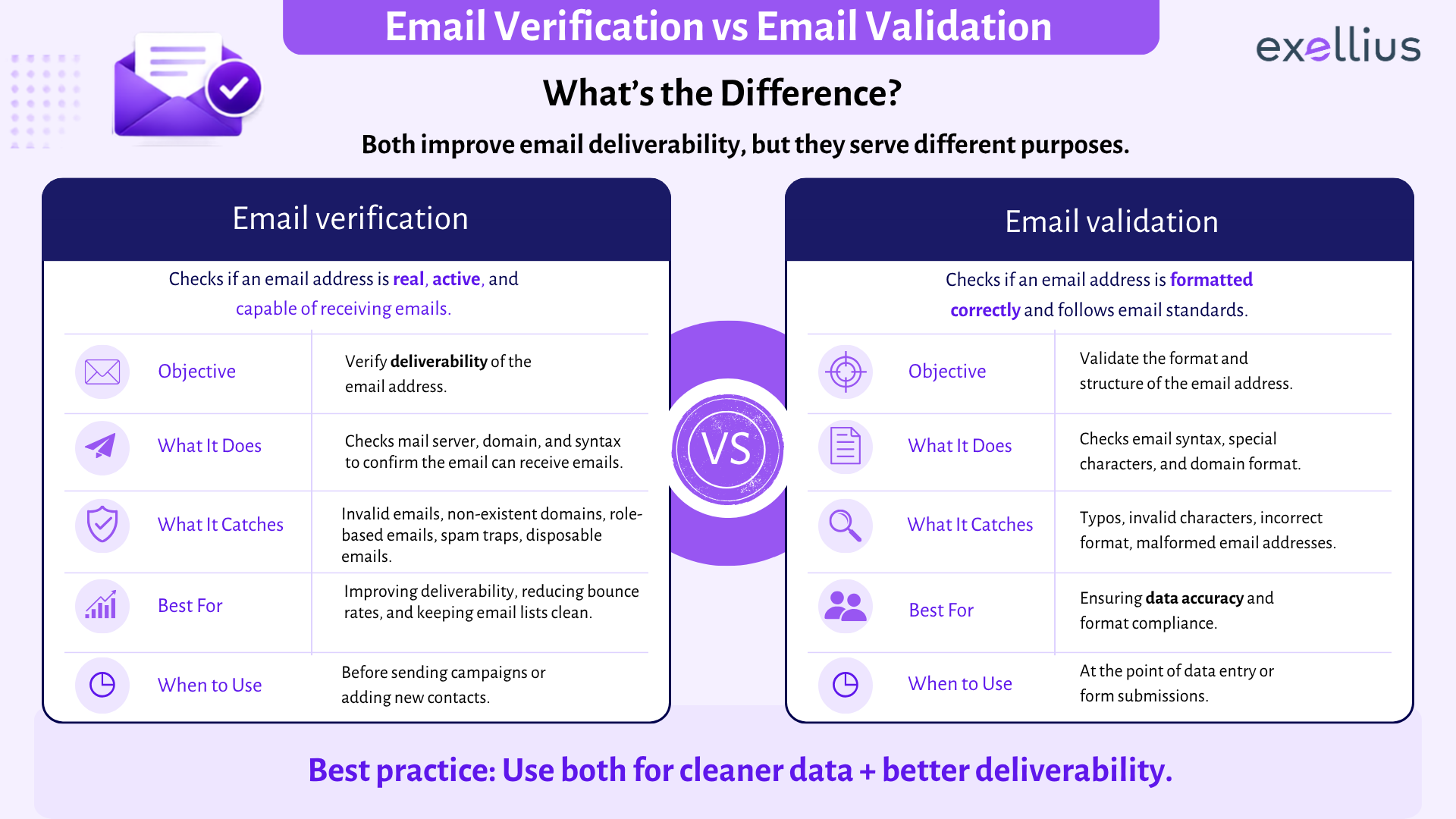
- Email and phone validation processes
- Data freshness optimization
Its primary value lies in ensuring that sales teams work with clean, verified, and actionable data before outreach begins, which directly impacts deliverability and conversion efficiency.
Key limitation:
Compared to ZoomInfo and Apollo.io, Exellius operates with a narrower ecosystem and is primarily focused on enrichment rather than full-cycle outbound execution.
Self Selection Framework:
From a revenue operations perspective, the decision between these platforms is less about feature comparison and more about workflow maturity and operational dependency.
- If the goal is enterprise-scale targeting and intelligence depth → ZoomInfo
- If the goal is fast outbound execution with integrated tooling → Apollo.io
- If the goal is clean CRM data and verified enrichment workflows → Exellius
This creates a natural self-selection framework based on budget, scale, and data dependency, rather than treating the tools as direct substitutes.
Final Positioning Logic
A realistic way to evaluate these platforms is through their core strengths:
- ZoomInfo = Enterprise intelligence depth with high cost and high data richness
- Apollo.io = Execution-first outbound platform with transparent pricing and workflow consolidation
- Exellius = Verification-led enrichment system optimized for data accuracy and CRM hygiene
No single platform fully replaces the others. Instead, they represent different layers of a modern B2B revenue stack, where intelligence, enrichment, and execution work together to drive pipeline performance.
Lead Discovery and Enrichment Workflow
Understanding enrichment workflows clarifies how these tools differ:
Step 1: Lead Capture
Leads enter systems through:
- Website forms
- Campaigns
- Events
- Third-party sources
Step 2: Data Cleaning
Incomplete or outdated records are identified.
Step 3: Enrichment Layer
Platforms enrich:
- Job titles
- Company details
- Contact information
- Industry classification
Step 4: CRM Sync
Updated records are pushed into CRM systems.
Step 5: Outreach Execution
Sales engagement tools run campaigns using enriched data.
Pro Tip: Teams that verify and enrich contact data before launching outreach campaigns consistently see lower bounce rates, better deliverability, and more reliable CRM data compared to teams relying only on raw contact databases.
Data Coverage vs Data Accuracy
ZoomInfo: Scale Advantage
Strong enterprise database coverage and intent data depth.
Apollo.io: Balanced Execution Model
Good coverage with built-in outbound functionality.
Exellius: Accuracy Advantage
Focused on improving data verification and enrichment reliability.
In real-world GTM systems, data accuracy often has higher impact on conversion rates than raw database size.
Feature Comparison
| Feature | Exellius | ZoomInfo | Apollo.io |
| Contact discovery | Medium | High | High |
| Data enrichment | Strong | Strong | Integrated |
| Email verification | High focus | Medium | Medium |
| Intent data | Limited | Advanced | Moderate |
| API access | Yes | Yes | Yes |
| CRM integrations | Yes | Yes | Yes |
| Outreach automation | No | No | Yes |
Pricing & Credit Model Comparison
Exellius (Credit-Based Model)
- Usage-based pricing
- Cost-efficient for enrichment-heavy workflows
- Scales with data volume needs
ZoomInfo (Seat-Based Enterprise Model)
- High-value enterprise contracts
- Pricing depends on access level and modules
- Designed for large GTM organizations
Apollo.io (Freemium + Subscription Model)
- Transparent tiered pricing
- Free plan available
- Popular among SMBs due to accessibility
Common B2B Data Enrichment Mistakes to Avoid
Many teams fail to get full ROI from enrichment not because of the tools, but because of how the process is managed. Most issues come from treating enrichment as a static activity instead of an ongoing data quality function.
1. Treating enrichment as a one-time task
Enrichment is often done once and never revisited, even though B2B data changes frequently due to role shifts, job changes, and company updates. This leads to outdated CRM records over time.
2. Prioritizing database size over data quality
Teams often choose platforms based on contact volume, but large databases without strong verification usually result in low-quality leads and higher bounce rates.
3. Not updating CRM with enriched data
When enriched data isn’t synced back into the CRM, sales teams continue working with incomplete or outdated records, reducing the impact of enrichment efforts.
4. Ignoring bounce-rate signals
Email bounces and invalid contacts provide critical feedback. Without feeding this back into enrichment workflows, teams keep targeting poor-quality data.
5. Using disconnected tools
When enrichment, CRM, and outreach tools are not integrated, it creates data silos, duplication, and inconsistent records across the sales process.
Decision Matrix
| Criteria | Exellius | ZoomInfo | Apollo.io |
| Database breadth | Medium | High | High |
| Data accuracy | High | Medium | Medium |
| Enrichment workflow | High | High | Medium |
| Outbound execution | Low | Medium | High |
| Pricing transparency | High | Low | High |
| Ease of implementation | High | Medium | High |
| SMB suitability | Medium | Low | High |
| Enterprise suitability | Medium | High | Medium |
Which Platform Should You Choose?
Choose Exellius if:
- You prioritize CRM data accuracy
- You need enrichment and verification workflows
- You want cost-efficient data hygiene
Choose ZoomInfo if:
- You need enterprise-level GTM intelligence
- You rely on buyer intent and segmentation
- You operate at large scale
Choose Apollo.io if:
- You want all-in-one outbound execution
- You need fast SDR workflows
- You prefer simplified tool stacks
FAQs
Is Exellius cheaper than ZoomInfo?
Yes, Exellius typically follows a credit-based model, which can be more cost-efficient than enterprise ZoomInfo contracts.
Is Apollo better for outreach automation?
Yes, Apollo.io is widely used for outreach automation due to its built-in sequencing and engagement features.
Which tool is best for enterprise buying signals?
ZoomInfo is generally stronger due to its intent data and enterprise intelligence capabilities.
Which platform is easiest for startups?
Apollo.io is usually preferred due to its simplicity and free-tier accessibility.
Which tool provides the most accurate data?
Exellius focuses on verification-led enrichment, making it suitable for improving data accuracy and deliverability.
What makes Exellius different from ZoomInfo and Apollo?
Exellius is primarily focused on data verification and enrichment quality, whereas ZoomInfo focuses on enterprise intelligence and Apollo focuses on outbound execution.
Is Exellius good for improving CRM data quality?
Yes, Exellius is designed for CRM hygiene and data enrichment workflows, helping teams maintain cleaner and more reliable customer data.
Which tool is best for verified email and phone data?
Exellius is better suited for verification-led workflows, making it useful for improving email deliverability and reducing bounce rates.
Can Exellius be used with ZoomInfo or Apollo?
Yes, Exellius can complement both platforms by acting as a data verification and enrichment layer before outreach or intelligence-driven targeting.
Is Exellius suitable for startups and small teams?
Yes, Exellius can be suitable for startups due to its credit-based pricing and focus on essential enrichment rather than complex enterprise intelligence systems.
When should a company choose Exellius over ZoomInfo or Apollo?
Exellius is the better choice when the priority is data accuracy, CRM cleanup, and verified enrichment, rather than full-scale outbound execution or enterprise intelligence.
Does Exellius improve email deliverability?
Yes, by focusing on verification-led enrichment, Exellius helps reduce invalid contacts, which can improve email deliverability and campaign performance.
Closing Summary
The comparison between Exellius vs ZoomInfo vs Apollo.io is ultimately about workflow alignment, not just feature comparison. Each platform plays a distinct role in the modern B2B revenue stack, intelligence, enrichment, and execution.
Selecting the right tool depends on whether your priority is data scale, execution speed, or data accuracy discipline.

Leave a Reply